Protocols, not promises
Rosemary Oil for Hair Growth: What One Real Trial Shows
By The GlowUp Hair Editorial Team · Updated 2026-08-18
There is one randomized trial worth knowing: 100 people with androgenetic alopecia used either rosemary oil or minoxidil 2% for six months, and both groups showed a significant increase in hair count at six months, with no significant difference between them and less scalp itching in the rosemary group research-backed [1]. That is genuinely promising and genuinely thin: one trial, one type of hair loss, and a comparison against the 2% strength of minoxidil, not the 5% most commonly used today.
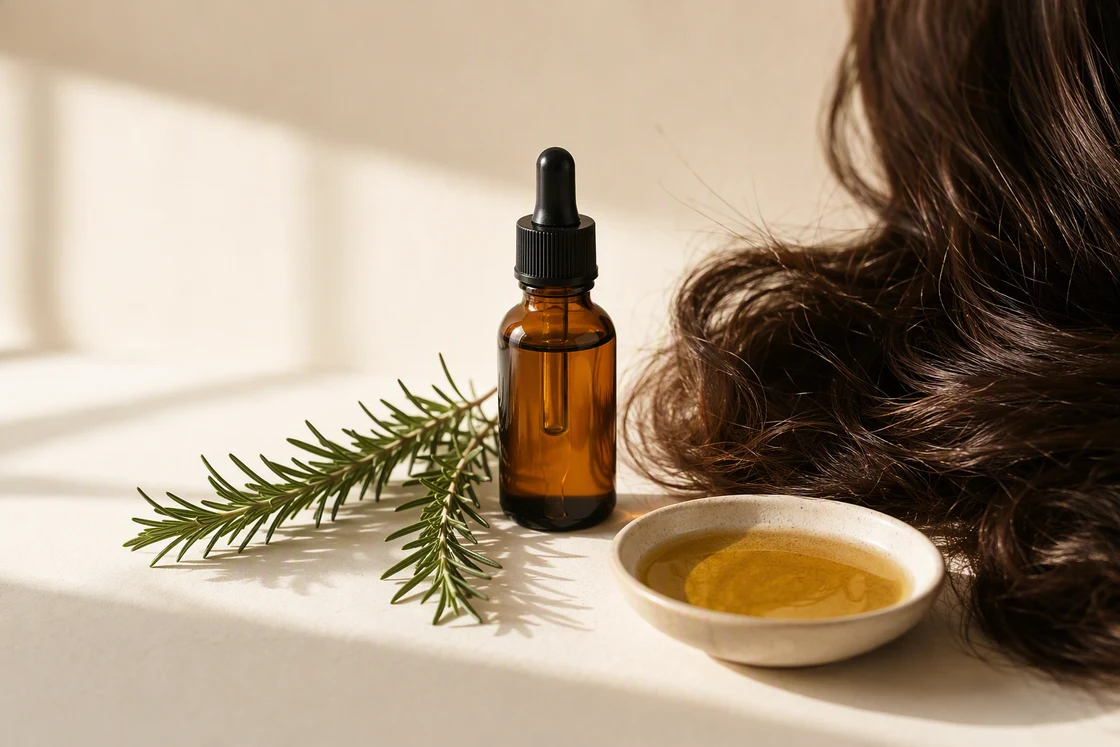
Does rosemary oil actually work for hair growth?
In one randomized trial of 100 people with androgenetic alopecia, rosemary oil performed comparably to minoxidil 2% on hair count at six months. That is real evidence, and it is also the only trial of its kind.
The study behind almost every rosemary oil claim you have seen is Panahi and colleagues, 2015 research-backed [1]. The design, in plain terms:
- Who: 100 people with androgenetic alopecia (pattern hair loss), randomized 50 to rosemary oil and 50 to minoxidil 2%.
- How long: 6 months, with standardized microphotographic hair counts at baseline, 3 months and 6 months.
- 3-month result: no significant change in hair count in either group.
- 6-month result: both groups showed a significant increase in hair count versus baseline, and there was no significant difference between the rosemary and minoxidil groups.
- Itching: scalp itching increased from baseline in both groups, but was significantly more frequent in the minoxidil group at both checkpoints.
So the honest one-line summary is: in this trial, rosemary oil kept pace with minoxidil 2% over six months and irritated scalps less. That is more evidence than almost any other natural hair product can point to. It is still one study, and the next section is about what it cannot tell you.
What are the limits of that study?
One trial, androgenetic alopecia only, compared against minoxidil 2% rather than the 5% standard, and with no placebo arm. "Comparable to minoxidil 2%" is the claim the data supports; "proven like minoxidil" is not.
Reading the trial carefully matters more than quoting it. The caveats, none of which are fatal and all of which are real:
- It is a single trial. No independent team has replicated it at similar size in humans. A 2020 systematic review of natural ingredients for hair loss found rosemary supported by this one comparative trial plus early-stage work, not by a body of confirmatory studies [3].
- The comparator was minoxidil 2%, not 5%. Today the widely used over-the-counter strength, especially for men, is 5%, which outperforms 2% in dose-comparison research. Matching 2% is not the same as matching the current standard.
- There was no placebo arm. Both groups improved at six months. Without an untreated or carrier-oil group, the trial cannot cleanly separate the treatments from massage, application ritual and time. It shows rosemary was not inferior to minoxidil 2%; it cannot prove either arm beat doing nothing in this population.
- It covers androgenetic alopecia only. Pattern hair loss has a specific, hormone-linked mechanism. The result does not transfer to shedding from stress, illness, postpartum changes or patchy autoimmune loss.
- Nothing happened at three months. Neither group improved at the 3-month check. Anyone judging rosemary oil at week six is judging it before the trial saw any effect from either treatment.
None of this makes rosemary oil a scam. It makes it a plausible, cheap, low-irritation option with exactly one good human trial behind it, which is precisely how we tag it.
How do you use rosemary oil for hair growth?
Dilute rosemary essential oil in a carrier oil, massage it into the scalp (not the lengths), leave it on, and repeat daily for at least six months. Patch test first.
The trial applied its rosemary preparation to the scalp daily for six months [1]. A practical protocol built on that and on standard essential-oil handling convention:
- Dilute it. Rosemary essential oil is not applied neat. A 1 to 2 percent dilution, roughly 3 to 6 drops per tablespoon of carrier oil, is the conventional leave-on range for scalp use.
- Pick a bland carrier. Jojoba, grapeseed, argan or fractionated coconut oil all work; the aromatherapy trial that included rosemary used jojoba and grapeseed as its carrier base [4]. The carrier is a vehicle, not the active.
- Patch test. Apply a small amount of the diluted mix to the inner forearm or behind the ear, wait 24 hours, and skip the whole experiment if you see redness, itching or stinging.
- Target the scalp. This is a follicle intervention, not hair conditioning. Part the hair, apply to the thinning areas, and massage in for a few minutes.
- Daily, then wash normally. Apply once a day. Some people leave it on for a few hours or overnight and wash out on their usual schedule; oils on the scalp count as product load when you plan washes, which our wash frequency guide covers.
- Commit to the timeline. Six months of daily use is what the evidence describes. If you will not sustain that, the data does not support expecting results.
Everything else in your routine stays the same; rosemary oil slots in as one targeted extra alongside the cleanse, condition and protect skeleton in our hair care routine guide.
How might rosemary oil work?
The leading hypotheses are mild blockade of the hormone pathway behind pattern loss and increased scalp microcirculation. Both come from lab and animal work, not confirmed human mechanisms.
Mechanism is where the evidence gets thinner, so tag it accordingly mixed evidence. Two hypotheses dominate:
- 5-alpha-reductase inhibition. Pattern hair loss is driven in susceptible follicles by dihydrotestosterone (DHT), which the enzyme 5-alpha-reductase makes from testosterone. In laboratory testing, rosemary leaf extract inhibited this enzyme substantially at high concentrations, and topical extract improved hair regrowth in mice whose regrowth had been suppressed with testosterone [2]. That is a coherent story for why rosemary might help androgenetic alopecia specifically. It is also mouse and test-tube data; enzyme inhibition in a dish does not establish the same effect in a human scalp at cosmetic doses.
- Improved microcirculation. Rosemary's compounds are argued to increase local blood flow, loosely analogous to one proposed action of minoxidil. This is the weaker-evidenced hypothesis of the two and rests mostly on general pharmacology rather than scalp studies [3].
The practical takeaway: the mechanism work makes the human trial result more plausible for hormone-driven loss, and it is exactly why there is little reason to expect rosemary oil to help hair loss that has nothing to do with DHT.
What will rosemary oil not do?
It has no evidence for stress or postpartum shedding, patchy autoimmune loss, traction damage, or eyebrow and lash growth. It also will not thicken the hair fiber you already have.
Most disappointment with rosemary oil comes from pointing it at problems the evidence never covered:
- Telogen effluvium (heavy shedding after stress, illness, surgery, weight loss or giving birth) resolves on its own timeline once the trigger passes. No rosemary study covers it, and its mechanism is not the DHT pathway rosemary is hypothesized to act on. If shedding is your problem, timing and trigger matter, not oil.
- Alopecia areata (patchy autoimmune loss) is a medical condition. One older randomized trial found benefit from scalp massage with a blend of essential oils including rosemary versus carrier oil alone [4], but rosemary was one of four oils in that blend, so it cannot be credited alone, and patchy loss belongs with a dermatologist regardless.
- Eyebrows and eyelashes. There are no trials of rosemary oil for brow or lash growth, and the eye area is a bad place for essential oils. Claims here are marketing, full stop.
- Traction and breakage. Loss from tight styles or damage is mechanical. The fix is tension and handling, covered in our routine guide, not a follicle stimulant.
- Thicker individual strands overnight. Any immediate cosmetic effect is oil coating the fiber, which every oil does and every wash removes.
Is rosemary water as good as rosemary oil?
Unknown, and probably not equivalent. Every human trial signal comes from oil or extract preparations; rosemary water is a homemade infusion with no standardization and no studies.
Rosemary water, sprigs simmered in water and spritzed on the scalp, is the social-media-friendly version of the protocol: cheap, light, no oil slick. The honest assessment is that it is untested mixed evidence. The compounds credited with rosemary's activity, such as carnosic acid derivatives identified in the enzyme work [2], are poorly water-soluble, so a kitchen infusion likely carries far less of them than an oil or concentrated extract, and the dose varies with every batch. No trial has evaluated rosemary water for hair growth.
If you enjoy it as a scented scalp mist, there is little downside beyond buildup between washes. If you want whatever effect the 2015 trial measured, use the form of the evidence: a rosemary oil preparation, applied daily, for six months [1].
When should you see a dermatologist instead?
Before starting a six-month oil experiment if your loss is sudden, patchy, inflamed or clearly beyond your normal shedding. Pattern loss also has stronger-evidenced prescription options worth knowing about.
Shedding 50 to 100 hairs a day is normal turnover; shedding beyond your own baseline for weeks is a reason for evaluation, not a bigger bottle of oil [5]. Go to a dermatologist first, not the product aisle, if you have:
- Sudden or rapidly worsening shedding, or handfuls coming out in the shower or on the pillow.
- Patchy bald spots, a rapidly widening part, or a receding pattern you want formally diagnosed.
- Scalp redness, scaling, pustules, pain or scarring alongside the loss.
- Loss after starting a medication, or alongside other symptoms like fatigue or weight change.
Two reasons this ordering matters. First, diagnosis changes everything: six months of rosemary oil aimed at telogen effluvium or a scalp condition is six months lost. Second, if it is androgenetic alopecia, a dermatologist can lay out the better-evidenced ladder, minoxidil 5%, prescription options, and procedures, next to rosemary oil's single trial, and early treatment preserves the most follicles [5]. This guide describes the evidence on a cosmetic botanical; it is not a treatment plan.
How long does rosemary oil take to work?
Plan on six months. In the only trial, neither rosemary nor minoxidil showed a significant hair count change at three months; the improvement appeared at six.
The trial timeline is the most useful expectation-setter in this whole topic, because it is the same timeline minoxidil showed in the same study [1]:
| Timepoint | What the trial measured | What you can realistically expect |
|---|---|---|
| Weeks 1-4 | Not assessed | No growth effect. Any change is cosmetic coating from the oil. Watch for irritation and stop if the scalp reacts. |
| Month 3 | No significant hair count change in either the rosemary or the minoxidil group | Nothing visible is normal and matches the data. Quitting here tells you nothing about whether it works. |
| Month 6 | Significant hair count increase versus baseline in both groups; no significant difference between them; less itching with rosemary | The earliest evidence-based checkpoint. Compare photos taken in the same light and part line, not memory. |
| Beyond 6 months | Not studied | Unknown. By analogy with minoxidil, benefits of a follicle stimulant likely require continued use, but rosemary has no long-term data. |
Take a baseline photo before you start. Six months is long enough for memory to rewrite what your part looked like in either direction.
Frequently asked questions
Does rosemary oil work as well as minoxidil?
In the one trial that tested it, rosemary oil matched minoxidil 2% on hair count at six months, with less scalp itching. That is not the same as matching minoxidil 5%, the strength most people use now, and one unreplicated study is weaker evidence than minoxidil's decades of trials. Fair summary: promising, less proven.
How long does rosemary oil take to grow hair?
The trial saw no significant change at three months and a significant hair count increase at six months. So the honest answer is about six months of daily use before judging, ideally against a baseline photo. Anything sold as a faster result is ahead of the evidence.
Should I apply rosemary oil every day?
Daily application to the scalp is what the study protocol used and what the six-month result is built on. A few times a week has simply not been tested. If daily is unsustainable for you, know that you are running a different experiment than the one with data.
Which carrier oil should I mix rosemary oil with?
Any bland, skin-tolerated oil works: jojoba, grapeseed, argan or fractionated coconut oil. The essential-oil trial in alopecia areata used jojoba and grapeseed as its base. The carrier is a diluent for safety and spread; no evidence says the choice changes hair results.
Can I use rosemary oil and minoxidil together?
They have not been studied together, so nobody can tell you the combination beats either alone. Layering an oil over minoxidil may also affect how the minoxidil sits on the scalp and can compound irritation. If you use prescription or OTC minoxidil, ask the prescribing clinician or a pharmacist before adding oils.
What are the side effects of rosemary oil on the scalp?
In the trial, scalp itching increased from baseline but was less frequent than with minoxidil 2%. Diluted properly, the main risks are irritation and allergic contact dermatitis, which is why a 24-hour patch test comes first. Undiluted essential oil on skin is a bad idea, and keep it away from the eyes.
Is rosemary oil safe for hair growth while pregnant or nursing?
Topical safety of concentrated rosemary essential oil in pregnancy and lactation has not been established, and pregnancy is also a common trigger for temporary shedding that resolves on its own. Skip the experiment and talk to your obstetrician, midwife or a dermatologist before using any essential oil during this window.
Does rosemary oil regrow a receding hairline?
The trial enrolled people with androgenetic alopecia, which includes hairline recession, and measured overall hair count rather than hairline position specifically. Long-receded, shiny areas with no visible follicles are unlikely to respond to any topical. A dermatologist can tell you which category your hairline is in.
Does rosemary oil help with hair shedding from stress?
No evidence supports it there. Stress-related shedding, telogen effluvium, follows its own cycle and typically recovers once the trigger has passed; rosemary's hypothesized mechanism targets the hormone pathway of pattern loss instead. If heavy shedding lasts beyond a few months, see a dermatologist rather than reaching for oils.
- Panahi Y, Taghizadeh M, Marzony ET, Sahebkar A. Rosemary oil vs minoxidil 2% for the treatment of androgenetic alopecia: a randomized comparative trial. Skinmed. 2015;13(1):15-21.
- Murata K, Noguchi K, Kondo M, et al. Promotion of hair growth by Rosmarinus officinalis leaf extract. Phytotherapy Research. 2013;27(2):212-217.
- Ezekwe N, King M, Hollinger JC. The Use of Natural Ingredients in the Treatment of Alopecias with an Emphasis on Central Centrifugal Cicatricial Alopecia: A Systematic Review. Journal of Clinical and Aesthetic Dermatology. 2020;13(8):23-27.
- Hay IC, Jamieson M, Ormerod AD. Randomized trial of aromatherapy. Successful treatment for alopecia areata. Archives of Dermatology. 1998;134(11):1349-1352.
- American Academy of Dermatology. Do you have hair loss or hair shedding?
Get the launch note More guides coming · [email protected]